Water Repellent and Water Proof, Can You Really Distinguish Between Them?

Perhaps you’ve had this experience: you happily took a walk in the rain wearing your own water-repellent jacket, but as you walked, you felt something was increasingly wrong… My clothes are obviously waterproof, so why did they still get wet?
In fact, "Water repellent" and "waterproof" are two different things. What is the difference between them?
Water repellent
Water repellent is abbreviated as W/R. Water repellent refers to the deposition of hydrophobic compounds on the fiber surface, leaving pores on the fabric surface, air and water vapor can still pass through, generally forming water droplets on the fabric surface (like lotus leaves). It is not really waterproof, but reduces the absorption of water by the fabric, so that water can be "repelled" on the surface of the fabric. Water will still penetrate into the fabric if it stays for a long time.
Water-repellent processing uses various chemical materials to attach a layer of ultra-fine "needle bed" on the surface of the fabric, making the surface tension of the fabric smaller than the cohesive force of water, so that when water drops, it forms water beads and rolls away instead of spreading and soaking. If this "needle bed" structure is flattened or covered with oil and infiltrated, the water-repellent ability of the fabric will be greatly reduced, and it may even start to absorb water. The water-repellent effect of the fabric will also gradually weaken with washing and long-term use, and may even fail.
Therefore, when you go out wearing water-repellent clothes on a rainy day, you can quickly shake off the water droplets on the surface of the clothes, but whether the clothes inside will get wet depends on the amount of rain and the time you stay in the rain. Water-repellent is not truly completely waterproof.
Water proof
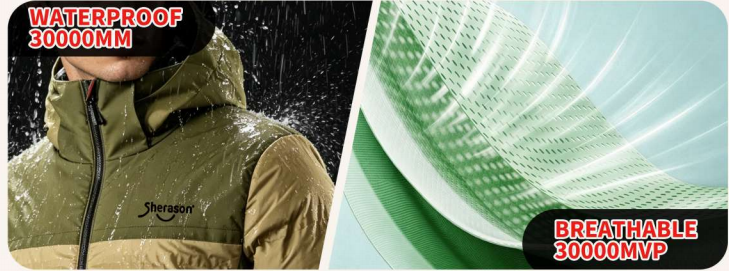
Waterproof which refers to waterproof and breathable fabrics. Generally, it refers to a rubber base on the bottom of the fabric, which is divided into coating and lamination. Coating is commonly referred to as coating, and lamination refers to lamination, which is a composite layer of waterproof material. Most waterproof fabrics use laminated (film) materials, and there are also various treatment forms such as capsule fiber, compact fabric, siliconization, etc., which are usually located in the inner layer of the fabric, which is often called "waterproof membrane".
The waterproof membrane is a composite fabric that is bonded with other fabrics through a gluing process. The fabric itself is not waterproof. Therefore, when we wear waterproof clothing and encounter wet weather, we will see water seeping into the clothing, just like clothing made of ordinary fabrics, but the inner layer of the clothing is dry. This is where the waterproof film in the middle of the composite fabric plays a role.
Waterproof ability is expressed by the water pressure resistance value, that is, a fixed area of waterproof cloth blocks the continuously rising water pressure. When the third drop of water seeps out of the surface, it is the water pressure resistance value of the fabric. Usually, the most basic waterproof ability can be achieved when it exceeds 1000 mmH2O.
Functional distinction between the two
1. Waterproof products are more durable than water repellent products, and their physical and chemical properties are more stable;
2. Waterproof products usually do not become ineffective due to washing and long-term use;
3. Waterproof products have a higher water pressure resistance index than water repellent products, usually at least 3000 mmH2O;
4. In the specific application of clothing, the main function of water-repellent treatment is to reduce the adsorption of water by the fabric so that the water can be "pushed away" on the surface of the fabric; waterproof treatment is a completely impermeable barrier that will keep water out regardless of whether the fabric absorbs water or not.
The Function and Structure of Ski Wear
Crafting Unforgettable Memories: A Family Camping Expedition
Related Article