The Difference Between Quick-drying Fabric, Water-repellent, Waterproof, Moisture-permeable, Breathable and Windproof Fabric?
The origin of quick drying
The quick-drying means that compared with wool or cotton clothes, the clothes made of this fabric are more likely to evaporate moisture and dry faster under the same external conditions.
Quick drying performance
Some people think quick-drying clothes are very mysterious, thinking that they contain a lot of high-tech ingredients. In fact, most quick-drying clothes are made of chemical fiber fabrics. It is only because of the different processing technologies that they have all kinds of magical effects that ordinary clothes do not have. They are not very absorbent, have good air permeability (depending on the material), have a certain degree of water repellency, and dry faster than ordinary clothes under the influence of body temperature or wind after being wetted.
The principle of quick drying
From a technical point of view, the main principles of waterproof and breathable quick-drying clothes are as follows:
- Utilize the difference between the minimum diameter of a water droplet and the diameter of a water molecule or air molecule.
- Use a microporous film. Make the micropore diameter of the film between the minimum diameter of a water droplet and the maximum diameter of a water molecule or air molecule, and then compound the film with the outer fabric to give the fabric waterproof and breathable functions.
- Utilize the interaction between the hydrophilic factors and hydrophobic factors of different components in the inner and outer layers of the fabric to achieve the effect of waterproof and breathable. Due to hydrogen bonds and other intermolecular forces, water molecules adsorb water molecules on the high humidity side, and are transferred to the low humidity side through the hydrophilic groups on the polymer chain for desorption, achieving the purpose of breathability.
- Utilize the characteristics of shape memory polymers. Shape memory polymers have a qualitative mutation in air permeability due to the micro-surface movement of the molecular chain. And its air permeability is adjusted with the change of external temperature and humidity. The waterproof and breathable fabric produced by this shape memory polyurethane can be produced by non-porous lamination or coating, which reduces the disadvantages of micropores generated during use due to micropores, such as blockage. More importantly, the moisture permeability of the fabric can change with the change of human body temperature.
Properties of water-repellent, waterproof, breathable, breathable and windproof fabrics
Water repellent:
Means that the fabric has been specially treated with a water-repellent agent, which can make water droplets on its surface form beads, and will not penetrate or diffuse to wet the clothes, achieving a water-repellent function like a lotus leaf (lotus effect).
Waterproof:
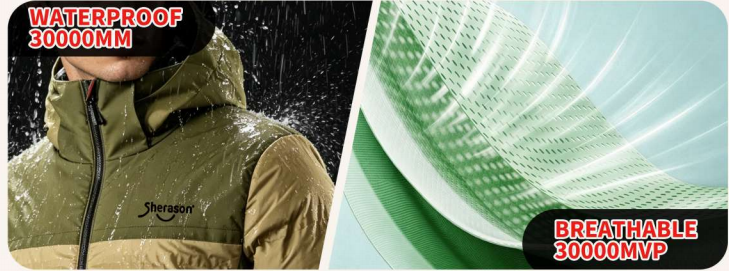
Functional treatment to prevent water from penetrating. Today's waterproof treatment often uses a waterproof membrane to prevent water molecules from penetrating, but the membrane itself is too fragile, so it depends on the cooperation of the surface fabric, the membrane, and the lining to achieve the waterproof function. The waterproof ability is expressed by the water pressure resistance value, that is, a fixed area of waterproof cloth blocks the continuously rising water pressure. When the third drop of water seeps out of the surface, it is the water pressure resistance value of the fabric. Usually, more than 1000mm can achieve the most basic waterproof ability.
Moisture:
Permeability refers specifically to the function provided by the indirect breathable waterproof film, not breathability, because they are two different breathability mechanisms, although they can eventually allow sweat to pass through the fabric to the outside. Moisture permeability requires sweat to be absorbed by the hydrophilic non-porous membrane and become sweat molecules inside. In the form of micro-Brownian motion, it is affected by the humidity pressure difference inside and outside the clothing and moves to the outside of the film, and then converted into gas and discharged through the surface fabric, so it is called indirect breathability.
Breathable:
In waterproof and breathable membranes, it specifically refers to the function provided by water-repellent porous waterproof films. Breathability allows gas to directly pass through the gaps in the "water-repellent porous membrane". Due to the high speed, it is called direct breathability.
All fabrics have a certain windproof function. The tighter the fabric is woven, the stronger the windproof ability is. The poor air permeability generally has a stronger windproof ability. High-quality fabrics are the perfect combination of air permeability and windproof.
What is Cationic Dyed Polyester Fabric? What is the Difference Between it and Nylon Fabric?
The Ultimate Care Guide For Coat And Jacket
Related Article