The Search for the "100% Waterproof" Jacket? The Truth, Technology, and Ultimate Selection Guide

In the world of outdoor gear, "100% waterproof" is a concept that is both alluring and full of misconceptions. When consumers get soaked through in a downpour, they think, "Isn't there a jacket that's truly 100% waterproof?" This article will reveal the truth, analyze the technical limits, and provide you with the ultimate selection strategy for getting as close to "absolute waterproofing" as possible.
The Hard Truth: Why the "100% Waterproof Jacket" is a Myth
First, we must face a frustrating fact: From the perspectives of physics and practical use, a permanently and absolutely 100% waterproof outdoor jacket does not exist. Here’s why:
Seams are the eternal weak point: Even if the fabric itself could resist infinite water pressure, needle holes and seams are always potential entry points. Fully taped seams have greatly improved this, but the risk of micro-leaks still exists.
The impermanence of DWR: The Durable Water Repellent (DWR) coating on the fabric's surface causes water to bead up and roll off, but it wears off with use and contamination from oils and dirt. When this happens, the fabric "wets out." While the inner waterproof membrane still blocks water, the jacket becomes heavy, breathability plummets, and the wearer feels damp and cold.
Usage dictates everything: An incompletely closed zipper, rain driving into cuffs or the neck, prolonged exposure to extreme water pressure (like under a waterfall)—any of these can cause even the top-tier jacket to "fail."
So, What Technology Gets Closest to "100% Waterproof"?
When we talk about top-tier waterproofing, we're really discussing a system comprised of three parts:
1. The Toughest Waterproof Fabrics
Gore-Tex Pro: The industry benchmark, especially Gore-Tex Pro Most Rugged. It uses a more abrasion-resistant face fabric and an enhanced membrane, designed for the most severe conditions.
- Layer Laminate Construction: Protective face fabric (outer layer) + ePTFE/PU waterproof membrane (middle layer) + protective backer (inner layer) permanently bonded together. More durable and longer-lasting than 2.5-layer or 2-layer constructions.
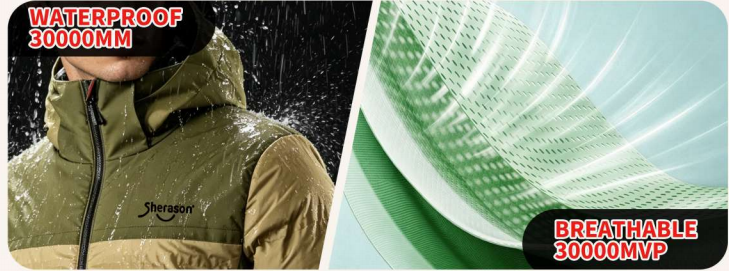
4-Waterproof Rating: Look for products rated above 28,000mm water column pressure. This is an extreme lab test metric but indicates potential.
Representative Fabrics: Gore-Tex Pro, eVent DV Expedition, Mountain Hardwear Dry.Q Elite.
2. The Most Meticulous Construction
Fully Taped Seams: All stitching on the inside must be covered with high-quality waterproof tape.
Waterproof Zippers: The main zipper should be a fully waterproof, sealed zipper (like YKK AquaGuard), not just a standard zipper with a flap.
Integrated Design: Minimize the number of seams. Hoods, pockets, and hems should use integrated construction or special waterproof treatments.
3. Critical Design Details
Adjustable Powder Skirt: Prevents wind and snow from entering from the bottom.
Helmet-Compatible Hood: With multiple 3D adjustment points to ensure visibility and protection in a downpour.
High Collar Design: An extended, waterproof storm collar.
Reinforced High-Wear Areas: Use of thicker or more durable fabric on shoulders, elbows, and areas of backpack contact.
Category-Based Selection for "Top-Tier Waterproofing"
Category One: Extreme Mountaineering & Expeditions (Unlimited Budget)
Goal: Withstand days of continuous blizzards and extreme high-altitude weather.
Top Choice: Arc'teryx Alpha SV or Beta SV
Why: Gore-Tex Pro Most Rugged fabric, minimalist seam design, cut optimized for harsh environments.
Strong Contender: Mountain Equipment Lhotse / Annapurna
Why: A classic British brand, designed specifically for Himalayan climbing with impeccable attention to detail.
Key Point: These jackets sacrifice some lightness and breathability for ultimate protection and durability.
Category Two: Multi-Day Backpacking in Torrential Rain
Goal: Keep the core torso dry during treks in rainforests or persistent heavy rain.
Top Choice: Patagonia Pluma (or Triolet)
Why: Excellent balance, Gore-Tex Pro fabric, strong focus on environmental durability, with excellent ventilation design.
Innovative Tech Representative: The North Face Futurelight Summit L5
Why: Uses nanospinning technology, claiming multiple times the breathability of traditional materials while achieving very high waterproofness. Has passed rigorous waterproof tests and is exceptionally soft and quiet.
Key Point: This scenario requires a balance of waterproofing, breathability, and durability.
Category Three: Professional Water Sports & Work (Kayaking, Sailing, Fishing)
Goal: Handle direct, continuous spray and immersion.
Top Choice: True professional sailing/whitewater jackets from brands like Kokatat, Musto, Gill.
Why: They use completely different standards (e.g., CE-certified waterproof ratings), feature drysuit-level sealed zippers and neoprene cuffs, and are designed to keep the wearer dry even during partial, short-term immersion. This is a fundamentally different design philosophy from mountaineering hardshells.
The "External Waterproofing" Game-Changer: Columbia OutDry Extreme
This is a revolutionary approach worthy of its own discussion. Traditional jackets are "outer fabric + internal waterproof membrane." OutDry places the waterproof membrane on the very outside.
Principle: The waterproof membrane itself is the outer surface; there is no outer fabric to wet out.
Advantage: It never loses water repellency because there is no DWR coating to fail. Performance remains exceptionally stable during prolonged rainfall.
Representative Product: Columbia OutDry Extreme Diamond. It often outperforms traditional 3-layer Gore-Tex jackets in extended rain tests.
Trade-off: The outer membrane may be less abrasion-resistant than traditional nylon, and the feel and look are distinctive.
Crucial Knowledge: Maintenance is Key to "Sustained High Performance"
Even with the best jacket, improper care will cause performance to degrade rapidly:
Regular Cleaning: Use technical cleaners to remove body oils and dirt that clog the fabric's pores.
Tumble Dry to Revive: Low-heat tumble drying helps reactivate DWR performance (for traditional jackets).
Inspect and Repair: Regularly check if seam tape is peeling and repair promptly with specific glue (note: specific glue type omitted in original, implies "specialized seam grip/glue").
Conclusion: How to Make Your "Ultimate Waterproof" Choice?
Abandon the "100%" fantasy, pursue the "most reliable system": Opt for a combination of top-tier fabric + top-tier construction + correct design.
Pay for your "worst-case scenario": Assess the most extreme weather you will actually encounter, not an imagined scenario.
Understand the trade-offs: Maximum waterproofing often means heavier weight, stiffer feel, relatively lower breathability, and a higher price.
Consider non-traditional solutions like OutDry: If you're primarily active in wet, rainy environments, it might be the more "maintenance-free" and reassuring choice.
Final Recommendation:
For the vast majority of outdoor enthusiasts, a professional 3-layer hardshell featuring Gore-Tex Pro or equivalent fabric, fully taped seams, and waterproof zippers is already the closest thing to a "100% waterproof" piece of gear available on the market. Products like the Arc'teryx Beta AR, Patagonia Triolet, and Mountain Hardwear Exposure/2 are standout examples in this category.
Remember, in the real world, a well-maintained, properly fitting top-tier hardshell, paired with appropriate mid-layers and moisture-wicking base layers, will perform infinitely closer to your dream of "100% waterproof" than any jacket alone. True "dryness" is a system, not just a single piece of clothing.
The New Directions for 2027 Outdoor Ski Wear and Mountaineering Jacket Development: Intelligent, Sustainable, and Boundless Performance
Snow Jacket vs Ski Jacket: Which One Do You Really Need? A Complete Guide to Key Differences
Related Article