Softshell Jacket VS Hardshell Jacket—How to Choose and What Different
When it comes to softshells and hardshells, it's time to start with the rash vest.
Hardshells were first used as the outermost layer of protective clothing during high-altitude climbs and summit ascents, and were popularly translated as: rash jackets.
At high altitudes, the weather conditions are often harsh, one minute it's windy and sunny, the next it's stormy.
Hard-Shell Jacket

--The ultimate protection against extreme weather such as heavy precipitation and high winds
The Hard Shell, also known as the 'rash jacket', is usually made from Gore-tex, eVent and other... They are made of tough, waterproof and breathable fabrics and are an important part of your hiking equipment. With it you can effectively combat the elements on outdoor trips, even in harsh climates.
The biggest challenge in the outdoors is the wind and rain, and as the Wind-Chill Factor often makes the body feel cooler than it actually is, a hardshell jacket is the perfect way to combat the highly wet and cold conditions by reducing the loss of body heat through effective wind protection and keeping your body warm and dry.
As well as being wind and water resistant, hardshell jackets are also often extremely hardwearing and are therefore often used as a barrier and protective layer.
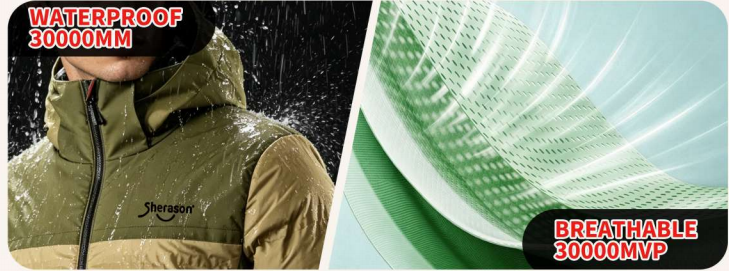
The waterproof function of the hardshell jacket is mainly due to the waterproof membrane. The fit is divided into 2L (2 layers), 2.5L (2.5 layers) and 3L (3 layers).
The more wet and cold the environment, the lower the body temperature, the more suitable it is to purchase a complex multi-layer composite hardshell jacket.
While the hardshell is highly waterproof, its relaxed fit allows for a thicker intermediate layer to be accommodated as required for insulation. This makes a hardshell the perfect choice for exploring brutal conditions.
The softshell jacket is usually made from elastane, which is flexible and soft, and also has a DWR water-repellent coating for light water resistance. In terms of outdoor wear, it falls somewhere between down and hard shell, providing warmth and a degree of weather resistance.

In terms of wearing experience, a softshell jacket is more comfortable than a hardshell (rash jacket). When you are hiking (sweating heavily and walking fast), the fabric of the softshell allows you to move more freely and quickly, and the breathability of a softshell jacket is basically better than that of a hardshell jacket. In less severe weather conditions, a soft shell jacket will be sufficient for wearing from start to finish in between hikes!
Unlike hardshells, which emphasise waterproofing, windproofness is an essential feature of all softshells. Some have micro-fleece on the inside and a waterproof coating on the outside. Although not as hard-wearing and waterproof as a hardshell, the whole garment has some warmth and water resistance.
The design of the softshell jacket is minimalist, and the exterior of the jacket has been stripped of excess parts so that they don't get hung up during exercise.
A great comparison of the performance of hard and soft shells
▼Waterproofness

The hard shell is waterproof with a PU coating and heat-sealed seams, so it is highly water resistant, protects against frost, snow and rain, and has strong abrasion resistance.
Softshells provide some protection in non-inclement weather and are generally coated with DWR water repellent treatment, which is sufficient for everyday use, but still slightly inferior compared to hardshells.
▼Breathability

In outdoor sports, because of the large amount of sweating, an outdoor garment with good breathability can quickly move this moisture out of the body, keeping the body comfortable and dry. Otherwise it can be dangerous to get cold and lose heat during outdoor sessions in bad weather.
But breathability and waterproofness are relative, and to get good waterproofness you have to sacrifice breathability as a price.
As advanced as current hardshell fabrics are, they still can't fully channel the sweat and water vapour generated during exercise, so hardshells are considerably less breathable than softshells.
The soft shell was designed with aerobic activity in mind, sacrificing some of its waterproofness for good breathability, making it suitable for sports with high perspiration, such as cycling, hiking and skiing.
▼Windproofness
In outdoor sports, cold winds can easily carry away body temperature and cause rapid heat loss, so the windproofness of the jacket is particularly important.
Softshells are divided according to the windproof principle: fabric windproof softshells and membrane windproof softshells, the former relying on the close arrangement of fabric fibres to provide windproof effect, with better breathability and comfort; the latter using a pressed windproof and breathable membrane, with better windproof isolation performance. Either material is sufficient for everyday use, but in extreme conditions, a hard shell is recommended.
▼Comfort
The softshell combines the functionality of a thermal layer with a protective layer. Compared to a hardshell, the fabric used will be softer, more comfortable to wear, and more elastic and stretchy when moving.
▼Warmth
In addition to the properties described above, warmth is also a major role of the rash jacket.
Softshells also have certain advantages when it comes to warmth. Softshell fabrics can be laminated with different thermal materials to improve their warmth. The hard shell itself does not provide warmth, so warmth still relies on intermediate warmth layers such as fleece, down or cotton.
When To Wear
It is a must for multi-day trips, as the climate can be very changeable and keeping your body dry is an important factor in avoiding temperature loss. For single day trips, it is advisable to check the weather conditions before you set off on your trip and if there is a chance of rain, you should bring it to ensure you are safe. If it is not likely to rain but you will be walking in windy terrain, a hard shell jacket (rash jacket) can be used as a windbreaker. However, it is important to note that a hard shell jacket cannot be used as a purely warm layer and it is often recommended to add a warm layer (down jacket, warm fleece jacket, etc...) to a hard shell in colder climates.
Softshell jackets have the advantages of being water resistant, breathable, wind resistant and comfortable and flexible. It is often used as an outer layer on multi-day hikes in good weather or as a mid-layer for resting at high altitudes, but in extreme weather conditions such as heavy rain, a softshell jacket is usually worn under a hard shell jacket (rash guard). Softshell jackets are usually available in thick or thin layers, but for summer hiking you can choose a thin softshell jacket for sun and wind protection.
The Difference Between A 3 in 1 Jacket And An Ordinary Outdoor Jacket ?
Can I Wear a Waterproof Jacket When Skiing?
Related Article