The Truth About Waterproof and Water-repellent Outdoor Fabrics

When going out to cope with the changing weather, waterproof jackets, trousers and even shoes are very important. However, I believe that many people are not particularly clear about the concepts of fabric waterproofness and fabric water repellency. When facing the increasing number of outdoor brands claiming that their products have waterproof functions, there will be some doubts. Which fabrics are really waterproof? Why do products that already use waterproof fabrics emphasize that they have been treated with water repellent? The editor will give you a simple introduction to the difference.
Fabric waterproofness usually refers to the waterproof function of the fabric itself. After the initial tight fabrics and coated waterproof fabrics, waterproof fabrics are now mainly pasted film fabrics. The key to playing a waterproof role lies in the functional film used in the fabric.
The pasted film fabrics that initially occupied the largest market share basically used PTFE (polytetrafluoroethylene) films. This type of film is a microporous membrane. The waterproof performance is expressed by the water pressure value that it can withstand. It is not 100% waterproof. According to European environmental research, PTFE materials will produce environmentally harmful compounds during manufacturing, landfill and incineration. In recent years, there have been more and more doubts about PTFE materials in the environmental protection community, and some countries have begun to restrict the use of PTFE materials. Landfill and incineration are the main methods of domestic waste disposal in the world. These two methods will produce perfluorinated compounds when dealing with PTFE materials. Fluorides will pollute the atmosphere and land. Due to the long period of natural decomposition of fluorides, the environmental pollution caused by PTFE materials will be long-lasting. In comparison, another type of film that has been adopted by more and more brands in recent years - non-porous hydrophilic membrane is not only non-porous and 100% waterproof, making the product waterproof performance more reliable, but some non-porous hydrophilic membranes are also favored by more industry insiders because of their environmental protection and harmlessness to the human body. For example, SympaTex? film is a molecular compound of polyether and polyester, absolutely does not contain PTFE (polytetrafluoroethylene), can directly contact the skin, is harmless to the body, and can be recycled like recycled PET plastic bottles.
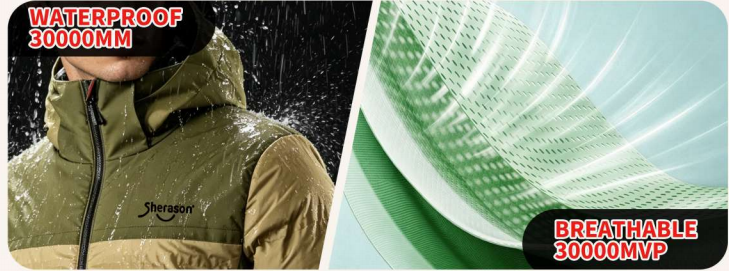
Usually, these fabric manufacturers with film technology do not sell films directly to clothing brands. They use the pasting process to compound the film with other materials to form a composite fabric (as shown in the figure above, the middle layer is a film). Brands only need to purchase these composite fabrics to directly make waterproof clothing products. These fabrics used to laminate with the film are not waterproof themselves, such as polyester fiber, nylon, etc., so when we wear waterproof clothing and encounter wet weather, we will see water seeping into the clothing, just like ordinary fabric clothing, but the inner layer of the clothing is dry and no water seeps in. This is the waterproof film in the middle of the composite fabric.
The situation that we see water dispersed into small water droplets on the clothing and then slides off (as shown above) is usually because the fabric used has been treated with water repellent. Water repellent treatment is actually a special treatment covering the surface of the fabric. Usually, DWR (Durable Water Repellency) is added when the finished fabric is finalized to obtain durable water repellent performance. The purpose of using DWR coating is that water can form small water droplets or slide directly from the surface of the clothing when dripping onto the surface of the clothing, thereby preventing the fabric from absorbing water. At the same time, it also makes it easier to remove oil stains attached to the surface of the clothing. Most waterproof clothing uses this DWR water repellent treatment. The advantage of using DWR treatment is that it can prevent the surface of the clothing from absorbing water, thereby ensuring that the waterproof fabric can achieve good breathability, so that the human body has a very good wearing experience.
DWR technology can be generally divided into two types based on relevant performance: fluoride-containing DWR and fluoride-free DWR. Fluoride-containing DWR refers to DWR surface treatment based on fluorinated polymers, such as PFOA (perfluorooctanoic acid), which is currently widely used in the clothing industry. Although it can provide high water-repellent, oil-repellent and stain-resistant properties, fluoride elements have the problem of being difficult to degrade and can be released into water sources and the atmosphere through various factors such as heat, water immersion, and ultraviolet rays, causing harm to humans and other animals and plants. Scientists have already found the presence of this compound in human and animal blood samples from all over the world. Although there is no evidence to point out the carcinogenic risk of PFOA and relevant regulations for the restriction of PFOA, the German Federal Environment Agency (UBA) has proposed to include PFOA in the list of chemicals suspected of being toxic to the reproductive system.
Currently, common DWRs that do not contain fluorinated carbons: wax, paraffin, polyurethane, dendritic polymers or siloxanes replace fluorocarbons as the basic elements as water-repellent recovery agents for outdoor products. Since mid-2008, SympaTex® has been offering consumers an environmentally friendly, fluorocarbon-free DWR product. This product was developed in conjunction with its partner Rudolf Chemie for textiles: BIONIC FINISHECO®. In fact, SympaTex® is also the first company to develop a fluorocarbon-free DWR product for textiles.
In the US EPA 2010/2015 PFOA regulatory process, major chemical manufacturers, including DuPont and Clariant, have also voluntarily committed to completely eliminate PFOA toxic chemicals from production by 2015 and replace them with more environmentally friendly, low-emission products.
It is worth mentioning that the DWR treatment is not permanent, but the correct washing and ironing methods can prolong the effect of the DWR treatment, and if your clothing loses its water-repellent effect, don't worry, DWR coating restorers are currently available on the market.
So you can see that clothing made of waterproof fabrics can basically achieve the functional requirements of 100% waterproof (PTFE film products under certain conditions, non-porous hydrophilic membranes under any conditions), but in order to obtain a more comfortable wearing experience and make these waterproof fabrics have a good breathable effect, DWR water-repellent treatment is also necessary.
In addition, the complete waterproofness of clothing is also closely related to the waterproof performance of the glue strips and zippers used at the seams, because the waterproofness and water-repellency of the fabric refer to the functionality of the fabric itself. If the pinholes at the seams or the gaps in the zipper are not treated, the clothing cannot achieve 100% waterproofness.
Combining Sustainability, Breathability and Moisture Management, Primaloft® is Improving the Performance of its Active Insulation Range
Good News! Sherason Bangladesh Factory is Coming!
Related Article